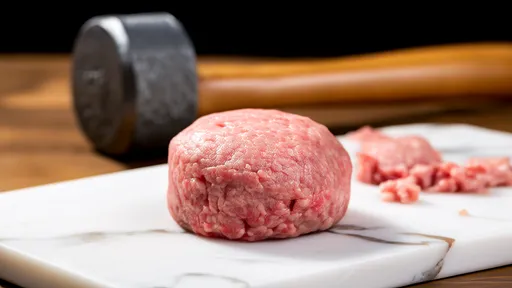
The rhythmic thud of wooden mallets against fresh beef echoes through the open kitchen of a small Chaozhou eatery, where a master butcher performs what looks like an ancient culinary ritual. This is the birthplace of the legendary Chaoshan beef ball – a deceptively simple dish that has captivated food lovers across China and beyond. The secret to its supernatural bounce? Forty minutes of relentless pounding that transforms ordinary beef into an elastic wonder.
In an era of industrial food production, the traditional method of making Chaozhou beef balls stands as a testament to the value of manual craftsmanship. Each batch begins with select cuts of lean beef from local cattle, carefully trimmed of all sinew and fat. The meat is then placed on a thick tree stump and subjected to a marathon pounding session using specially designed wooden hammers. This prolonged mechanical action breaks down muscle fibers while preserving their structural integrity, creating a unique protein matrix that gives the balls their characteristic springiness.
Food scientists have taken particular interest in what happens during those forty minutes of pounding. The repeated impact causes myosin proteins to unravel and form cross-links, creating what researchers call a "heat-set gel." When cooked, this network of proteins contracts uniformly, forcing moisture into the center of the ball and creating that signature bounce. Industrial processors attempt to replicate this effect with machines, but connoisseurs insist that only hand-pounded balls achieve the perfect balance of elasticity and tenderness.
The elasticity test has become something of a spectacle in Chaozhou restaurants. Cooks proudly demonstrate how a properly made beef ball can bounce to knee height when dropped on a hard surface. Some establishments even hold competitions, with veteran chefs producing balls that rebound to waist level. This quality check isn't just for show – it's a centuries-old standard that separates authentic Chaozhou beef balls from inferior imitations.
Modern variations have emerged, including versions with fillings or mixed with other ingredients, but purists maintain that the true test of skill lies in producing perfect plain beef balls. The texture should be firm enough to provide resistance when bitten, yet tender enough to chew comfortably. When sliced open, the interior should reveal a network of tiny air pockets created during the pounding process – nature's proof of manual labor.
As demand grows, some shops have begun offering pounding demonstrations, allowing customers to witness the transformation from raw meat to bouncy delicacy. The process has become a tourist attraction in its own right, with visitors marveling at the endurance required to pound meat continuously for forty minutes. Behind the scenes, veteran pounders develop distinctive techniques – some prefer a steady, metronomic pace while others employ alternating heavy and light strokes.
The future of this traditional craft faces challenges as younger generations seek less physically demanding work. Some shops have begun using mechanical pounders, though they adjust speed and pressure to mimic human technique. Yet in Chaozhou's most revered establishments, the wooden mallets still fall with the same rhythm they have for generations, preserving not just a recipe but an edible piece of cultural heritage that quite literally bounces back when put to the test.

By /Aug 11, 2025

By /Aug 11, 2025
By /Aug 11, 2025

By /Aug 11, 2025

By /Aug 11, 2025
By /Aug 11, 2025
By /Aug 11, 2025
By /Aug 11, 2025

By /Aug 11, 2025

By /Aug 11, 2025
By /Aug 11, 2025

By /Aug 11, 2025

By /Aug 11, 2025

By /Aug 11, 2025

By /Aug 11, 2025

By /Aug 11, 2025

By /Aug 11, 2025
By /Aug 11, 2025
By /Aug 11, 2025
By /Aug 11, 2025
