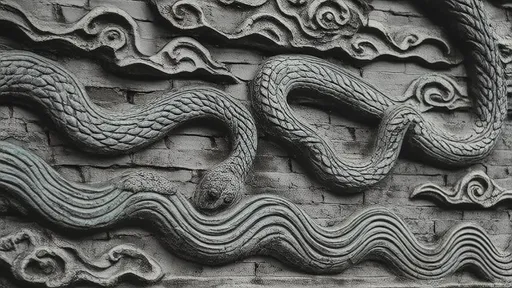
The art of Huizhou brick carving stands as a testament to China’s rich cultural heritage, where stone and narrative intertwine to create a vivid tapestry of folk traditions. Nestled in the mountainous regions of southern Anhui, these intricate carvings are more than mere decorations—they are three-dimensional storybooks, preserving legends, morals, and the daily lives of generations past. The craft, which flourished during the Ming and Qing dynasties, transforms humble clay into enduring masterpieces, each chisel stroke echoing the voices of artisans long gone.
What sets Huizhou brick carvings apart is their ability to compress entire sagas into a single panel. A single brick might depict a scene from "The Romance of the Three Kingdoms" or a local folktale about filial piety, with layered perspectives that draw the viewer into its depths. The artisans employed a technique called "openwork carving", where negative space is as crucial as the solid forms, allowing light to dance across the surfaces and animate the stories. These carvings were often integrated into the architecture of ancestral halls and merchant residences, serving as both aesthetic marvels and didactic tools for the community.
The motifs found in these carvings reveal a fascinating blend of Confucian values and Taoist mysticism. Dragons coil around scholars’ study tables, symbolizing the pursuit of wisdom, while cranes soar alongside peaches of immortality. One recurring theme is the "Four Gentlemanly Pursuits"—qin (music), qi (chess), shu (calligraphy), and hua (painting)—etched with such precision that the strings of a guqin seem almost audible. Yet, interspersed with these lofty ideals are whimsical vignettes of market vendors, children at play, or even mischievous foxes from local folklore, grounding the art in human experience.
Modern scholars face a race against time to document these vanishing narratives. Humidity, pollution, and rural depopulation have left many carvings crumbling in abandoned villages. A 2018 survey by the Anhui Cultural Heritage Bureau found that nearly 40% of recorded brick carvings showed significant deterioration. Efforts are underway to create high-resolution 3D scans of the most endangered pieces, but the true challenge lies in deciphering the oral traditions that once accompanied them. Elderly craftsmen, some now in their 90s, hold the keys to interpreting symbols that have baffled contemporary researchers—like why certain flowers appear only beside military scenes or the hidden meanings behind fractured moon motifs.
Beyond preservation, contemporary artists are reimagining this ancient medium. At the 2023 Hangzhou Design Biennale, a striking installation fused laser-cut titanium with traditional brick carving patterns, projecting digital shadows that retold the story of the White Snake across gallery walls. Meanwhile, in Tunxi’s old quarter, young apprentices experiment with injecting modern social commentary into classical forms—one controversial piece juxtaposes ancient farming scenes with smartphone icons, questioning technology’s role in eroding communal bonds. These innovations spark debates about cultural authenticity but ensure the artform’s relevance in a rapidly changing China.
The global art market has begun taking notice. A Huizhou carving panel depicting the Eight Immortals Crossing the Sea fetched €78,000 at a 2022 Berlin auction, surpassing its estimate by 300%. This surge in interest has led to troubling instances of looting from unprotected sites, prompting local authorities to install motion-sensor cameras in remote villages. Yet, for all their monetary value, the true worth of these carvings lies in their ability to bridge centuries. When sunlight filters through the pierced bricks of a restored Qing-era courtyard, illuminating scenes of harvest festivals and mythical battles, the stones seem to whisper—not just of the past, but of humanity’s enduring need to shape stories from the earth itself.

By /Aug 11, 2025
By /Aug 11, 2025

By /Aug 11, 2025

By /Aug 11, 2025

By /Aug 11, 2025

By /Aug 11, 2025

By /Aug 11, 2025

By /Aug 11, 2025

By /Aug 11, 2025

By /Aug 11, 2025
By /Aug 11, 2025

By /Aug 11, 2025

By /Aug 11, 2025

By /Aug 11, 2025
By /Aug 11, 2025
By /Aug 11, 2025

By /Aug 11, 2025
By /Aug 11, 2025
By /Aug 11, 2025
By /Aug 11, 2025
